Image credit: Pixabay
The advent of AI is so rapid that it is altering the way companies work across their various departments, ranging from customer support to compliance and even creative areas. Although these tools claim to provide the highest efficiency ever seen, they are already beyond the reach of the moral and legal frameworks that are meant to control them.
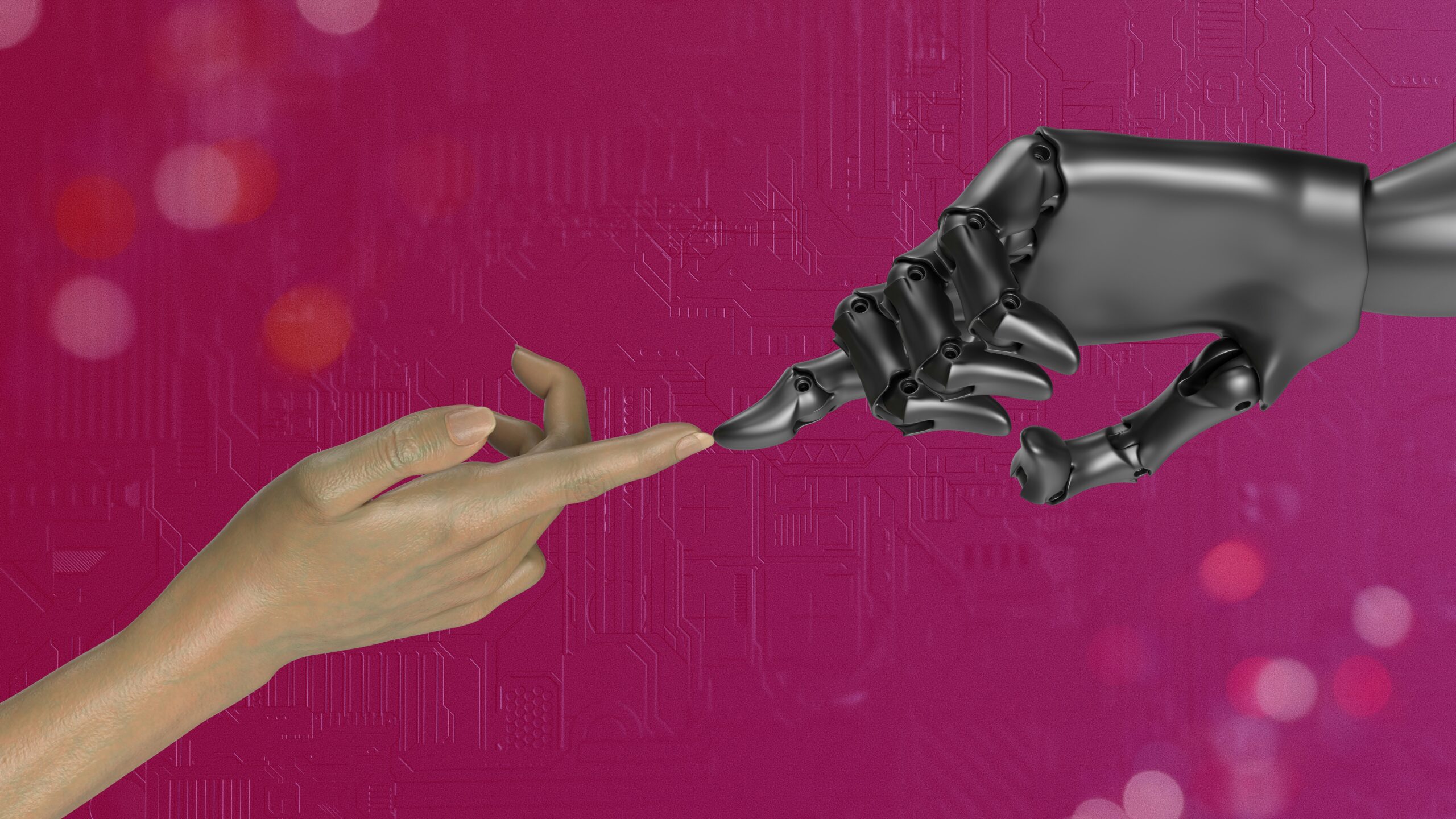
To fill the void, many organizations are adopting “human-in-the-loop” systems, which are models that intentionally keep human beings at the center of the decision-making process, oversight, and accountability.
This approach is quickly becoming a defining feature of responsible innovation, offering a way to balance AI’s precision with the judgment, nuance, and context only humans provide.
AI Co-Pilots Transforming Customer Experience
Companies like Blue Stream Fiber demonstrate what happens when AI is deployed with deliberate guardrails and a philosophy of automating tasks rather than replacing people. Their SVP of AI Strategy and Deployment, Joshua Turiano, has overseen the creation of systems such as the Support Guru and Field Tech Guide, both designed to empower support teams. Turiano’s perspective comes from his early career in a call center, where he experienced firsthand how much manual work and tribal knowledge were required to solve customer problems. With today’s AI, even a new hire with two weeks of experience can access the same level of domain insight as a veteran agent.
Turiano explains that the rule guiding every implementation is simple: automate tasks and keep people in control. Routine comparisons, triage checks, and data retrieval that once consumed thousands of work hours are now handled instantly by AI agents. The payoff is significant. As much as 70 percent of daily work orders can now proceed without manual intervention, and the remaining cases are intentionally escalated for human review.
He warns, however, that companies must avoid complacency. “Too much reliance on it is a bad thing,” he says, stressing that the system is built so humans remain responsible for oversight, anomaly detection, and final decisions. Even with early returns as high as nine thousand percent ROI within ninety days, Turiano maintains that the human-in-the-loop approach is what protects accuracy, ethics, and customer trust.
He also emphasizes that responsible AI starts with policy, governance, and strict data boundaries. Blue Stream Fiber limits its models to non-identifiable information through tightly controlled APIs. Nothing that can personally identify a customer is ever given to an external model. Without these rules, Turiano says, AI becomes a version of the wild wild west, and companies risk exposing sensitive information to public systems without realizing it.
Human Oversight Anchoring Compliance and Risk Management
In the compliance and ethics space, the sensitivity of the information makes AI both transformative and risky. Shannon Walker, Founder of Whistleblower Security and Executive Vice President of Strategy at Case IQ, has spent two decades helping organizations manage misconduct reports responsibly while protecting people who come forward. She describes AI as a major turning point that is both exciting and daunting, and one that absolutely must be surrounded by clear guardrails.
Walker notes that organizations adopting AI-supported intake or investigation systems must communicate clearly about how data is collected, parsed, and modeled. Trust depends on users understanding exactly where their information goes and how it is protected. For platforms like Case IQ, that means openly discussing the role of AI with clients and building tools such as Clairia, an AI assistant that surfaces trends and links cases without ever exposing sensitive data to external training environments.
She points to California’s SB 53 as an example of how legislators are beginning to introduce oversight without punishing smaller startups. At the same time, she warns that many organizations still operate in silos where employees unknowingly upload confidential information into public AI tools. Without proper awareness and controls, this becomes a serious ethical and operational risk.
To avoid over-reliance, Walker says companies must prioritize collaboration and continuous iteration among developers, compliance leaders, and users. AI systems should be monitored for hallucinations, bias, and unsafe actions, and tools like LangSmith can help teams track these issues as they arise. “If you are operating in a silo, you will have issues,” she says. Transparency, feedback loops, and regular adjustments keep AI aligned with real-world needs.
Walker is optimistic about the future. With proper oversight, AI can reduce retaliation risk, strengthen case management, and help companies detect patterns earlier. But she is clear that responsibility comes first. “There have to be guardrails. People need to be very confident that when they are giving you sensitive information, it is protected.”
Ethical Guardrails in Creative and Strategic Workflows
In creative and communications work, AI is accelerating production so quickly that many teams cannot keep pace with the ethical considerations that should accompany these tools. Whitney Hart, Chief Strategy Officer at Avenue Z, has seen this tension growing for years. “It feels like someone pressed the fast forward button after COVID,” she says. “Everyone is trying to move faster and faster, and the acceleration is outpacing the frameworks that are needed to maintain trust.”
Hart’s background spans AI-driven marketing, Web3, blockchain, and data privacy, and she believes many brands are adopting AI without understanding the foundations of the tools they use. “People are not taking a step back and asking whether the outputs make sense,” she says.
Hart notes that personifying AI leads teams to mistakenly believe the system possesses empathy or moral reasoning. “It’s an algorithm that executes based on a training data set and the way that algorithm was designed. People forget that,” she says. Not all models are built the same way. Hart describes that some systems are trained with social media content, while others are trained with human-aligned constitutional documents. “Its point of view is aligned to its training data. That matters more than people realize,” she explains.
To manage these risks, Avenue Z formed an AI Council more than a year ago. The council oversees education, tool selection, data governance, and client transparency. “We do not use AI tools without talking to the client first,” Hart illustrates. “We walk them through how it fits into the workflow and get their buy-off. No one should be surprised about how their data is being used.”
Many companies outside the agency world lack any unified strategy at all. The result is what Hart calls “rogue activity” within organizations, where employees upload confidential data into personal AI accounts without understanding the consequences.
The next several years, Hart believes, will be defined by tension among AI providers, regulators, creators, and users. “There is going to be a lot of friction,” she says. “Everyone is trying to get the maximum value from these systems, but the legal and ethical frameworks are still catching up.” She hopes that as literacy increases, companies will adopt more conscious and transparent technology practices. “We need people to press pause,” she says. “We need them to think about what they are using, why they are using it, and whether the outputs actually make sense.”
The Path Ahead
Different industries are realizing that concerns over the responsible use of AI are unlikely to slow down its adoption. Instead, the focus has shifted to the use of systems that will bolster human governance and make the whole process more transparent. Organizations are demonstrating that AI adoption can be done ethically and safely, even in large-scale applications, by establishing governance structures and ensuring that people are involved in the process at key stages.
As technology advances, the most effective strategies will be those that consider AI as a powerful assistive device, rather than a replacement for human intelligence. As the world enters a human-in-the-loop era, it is empowerment, rather than substitution, that is driving the future of innovation.